
Trucks
Your business.
Powered by gas.
When you have access to gas fueling infrastructure, a new world of possibilities opens up for your truck and your business. Our gas-powered trucks and their engines deliver performance, power, and fuel efficiency on a par with our diesel trucks – but with the added benefit of up to 10-20% lower net emissions using LNG or CNG that goes all the way up to 70-100% for bio-LNG and bio-CNG. Explore here how gas can start powering your business.
The performance you need
Delivering smooth acceleration, power, and torque on a par with diesel engines, and long range up to 1000 km, Volvo’s gas-powered trucks are suitable for many operations – including long-haul transport, distribution, and on-road construction.
Lower emissions – and costs
Developed and refined over the years, our gas-powered engines offer high fuel efficiency to lower your operating costs. And with a choice of renewable bio-LNG or bio-CNG, you can reduce net CO₂ emissions by as much as 100%.
Support every step of the way
It can feel like a big step to move to a gas-powered truck or integrate them into your current fleet. We’re here to help you make the right choice of truck for your needs and integrate it seamlessly into your business.
How can we help you?
Show me what Volvo gas-powered trucks can do
Tell me more about how gas can power my business

Ready when you are
Gas-powered trucks are increasingly common across a full range of transport applications. And a valuable alternative for customers looking to get the productivity, fuel efficiency, sustainability, and flexibility their operations demand. Explore the advantages of a gas-powered business – and when you’re ready to take the next step, we’re here to support you all the way.
Up to 1000 km
Range of Volvo’s gas-powered trucks
Up to 60 tonnes
Load-carrying capacity of our gas-powered trucks
Up to 100%
CO₂ emissions reduced by using bio-LNG
10 000+ trucks
More than 10 000 Volvo gas-powered trucks have been sold worldwide
Power and range for high productivity
With gas-powered models of the Volvo FH Aero, Volvo FH, Volvo FM, and Volvo FE, you can find the right truck for the job and for your business. From long-haul and regional transport to on-road construction and waste and recycling operations, you’ll get the power, range, load capacity, and chassis you need to make every day productive.


Fuel efficiency for lower operating costs
Thanks to the latest driveline technology, fuel-saving features like the I-Shift automated transmission and I-See predictive cruise control, and digital efficiency and uptime services, our gas-powered trucks help you maximize performance while minimizing fuel consumption and costs.
A big step toward sustainability
In addition to fuel-efficient engines and services, gas-powered trucks help you cut CO₂ emissions significantly – up to 100% with bio-CNG or with bio-LNG using HVO100. As well as reducing NOx and other particulates depending on the fuel you choose. Of course, this isn’t just important for our shared net-zero targets, it’s also increasingly a demand from transport buyers and essential for winning many tenders.


The flexibility to adapt
Gas-powered trucks can deliver the productivity, efficiency, and sustainability a modern operation needs. They also give you more flexibility such as moving from LNG to bio-LNG when the cost and supply are more viable. Or as part of a mixed fleet where you start your transition away from diesel. With our expert knowledge and infrastructure advice as well as operational support and financial services, you’ll have the options you need to navigate the future with confidence.
Find your gas-powered truck
Discover Volvo gas-powered trucks. We’ll help you choose the right truck for your specific needs and support you with solutions that address your infrastructure, range, and productivity demands.
- Volvo FH Aero gas powered
- Volvo FH gas powered
- Volvo FM gas powered
- Volvo FE CNG
Volvo FH Aero gas-powered
The Volvo FH Aero is the ideal long-haul truck for hauling body types like trailers, semi-trailers, containers, and curtainsiders. Its aerodynamic cab silhouette is designed to save you energy and reduce your carbon footprint.
Power: Up to 500 hp
Torque: Up to 2800 Nm
Range: Up to 1000 km
Fuel: LNG or bio-LNG

Volvo FH gas-powered
The Volvo FH gas-powered can cover long distances with a high payload while helping reduce CO₂ emissions – by up to 100% reduction when using bio-LNG with HVO100. Ideal for long and regional haul, building and construction, forest and timber, agriculture, and public services and utilities assignments.
Power: Up to 500 hp
Torque: Up to 2800 Nm
Range: Up to 1000 km
Fuel: LNG or bio-LNG

Volvo FM gas-powered
The Volvo FM is a flexible heavy-duty truck that also helps you lower CO₂ emissions. It’s ready to take on any assignment with ease – from long and regional haul and distribution to waste and recycling and public services and utilities.
Power: Up to 500 hp
Torque: Up to 2800 Nm
Range: Up to 1000 km
Fuel: LNG or bio-LNG

Volvo FE CNG
The Volvo FE CNG is an efficient and sustainable choice for waste and recycling and distribution assignments in cities and urban areas – especially when operating on biogas (bio-CNG).
Power: 320 hp
Torque: Up to 1356 Nm
Range: Up to 400 km
Fuel: CNG or bio-CNG


Tailor your next
gas-powered truck
Customize and design your ideal truck that perfectly meets your requirements.

Services you can trust
With the right service contracts, an expert workshop, and valuable digital services, you can keep your gas-powered truck performing at its very best. We’ve got service contracts for gas-powered trucks that give you complete coverage, plus a whole host of Volvo Connect digital services – from driver support tools to a clear overview of your fuel consumption and an up-to-date list of fueling stations, so you can plan your routes more effectively.

Frequently Asked Questions (FAQ)
Bio-LNG, also known as liquefied biogas, consists primarily of methane, just like LNG. Bio-LNG is a non-fossil fuel produced from organic waste such as animal manure, sludge, and food waste. In comparison with LNG, bio-LNG has significantly lower CO₂ emissions. It also has higher fuel potential (the ability to replace diesel) than other renewable alternatives like biodiesel. When operating a Volvo FH Aero, FH, or FM gas-powered truck, you can switch from LNG to bio-LNG when it makes most sense.
The only difference between bio-LNG/LNG and bio-CNG/CNG is that the latter is compressed at high pressure and stored in tanks on the truck. The downside with compressed gas is that it means a shorter range for the truck than when driving on liquefied gas. Bio-CNG can be produced locally and is a non-fossil fuel while CNG is a fossil fuel. With the Volvo FE CNG truck, you can switch from CNG to bio-CNG when the cost and availability are favorable.
LNG is non-toxic, non-carcinogenic, and does not ignite in liquid form. It requires high temperatures to burn – and even then there will be a slow burn rather than an explosion. Due to LNG being stored as cold as -162 Celsius, care is required around handling and minimizing the risk of human contact.
Features depicted may not be standard or available for all equipment levels and powertrain options.
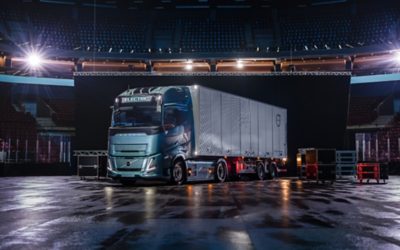
Gas-powered trucks deliver new opportunities
With over 10 000 sold globally, we’ve built up a lot of expertise in helping customers successfully fit gas-powered trucks into modern fleets and sustainable operations. Here, you can read what our customers have to say as well as share our insights from different industry segments.
Customer success
Fully focused on recycling
The waste and recycling company Sortera uses Volvo trucks that run on bio-LNG. Whether it’s through their business operations or how they fuel their fleet, Sortera ensures that waste is transformed into resources.
“It was a very easy transition to gas-powered trucks, and it really wasn't a big step for our drivers. The only difference is that they found the trucks quieter to drive.” – Peter Bergström, Purchasing and Downstream Manager, Sortera Group AB


Customer success
Efficient power every day
“We think it’s the best option for long-haul transport. The trucks are really efficient. And with the Volvo FH gas-powered with 500 hp we see what a difference it makes in fuel consumption and power when we drive heavier loads.”
– Erik Alfredsson, CEO, Alfredsson Transport
“It doesn't matter if you are carrying 60 tonnes or 35 tonnes, the truck feels the same.”
– Peter Johansson, Driver, Alfredsson Transport
The truth about LNG and bio-LNG
Powerful, efficient – and safe!
Are you thinking of adding an alternative driveline to your fleet? Changes in emissions regulations and developments in new technology are making gas-powered trucks – using either LNG or bio-LNG – an increasingly viable option for many businesses. What’s more, liquefied natural gas is non-toxic and non-flammable in liquid form. Extra care is needed when handling as it’s stored at ultra-low temperatures, but otherwise liquid natural gas is a safe way to power your trucks and your business.


Customer success
Bio-LNG is in our nature
"We’ve gotten a lot of attention from colleagues in the industry. Many are curious – and skeptical. But when they see that it works, something starts to happen. Bio-LNG is already an effective and sustainable complement to diesel.”
"I love the forest. I live in the country, I hunt, and I enjoy working close to nature. And it feels extra good that we can do it without burdening the environment.”
– Patrik Lindgren, CEO and driver, Hestra Transport
Can gas-powered trucks
work for you?
Moving to a gas-powered truck doesn’t have to be difficult. Our experts are on call to walk you through the process and guide you towards the right solutions.

Volvo Trucks stories
Explore Volvo stories for more in-depth exploration of the world of Volvo Trucks, our customers, our people, and our business.
Features depicted may not be standard or available for all equipment levels and powertrain options.